New legislation tackles forced labour and child labour in Canada’s supply chain
The Government of Canada is the latest country to pass legislation banning the import of goods produced with the forced or child labour. Bill S-211 accomplished two things:
- It enacted the Fighting Against Forced Labour and Child Labour in the Supply Chain Act which includes mandatory reporting, which is detailed below, and
- It amends the Customs Tariff, which prohibits the “importation of goods manufactured or produced, in whole or in part, by forced labour or child labour”.
What does my business need to do?
- Determine if your business required to submit a report under this new Act
- Understand the reporting requirements
- Understand what you might be asked even if you aren’t required to report.
Determining if your business required to submit a report under this new Act
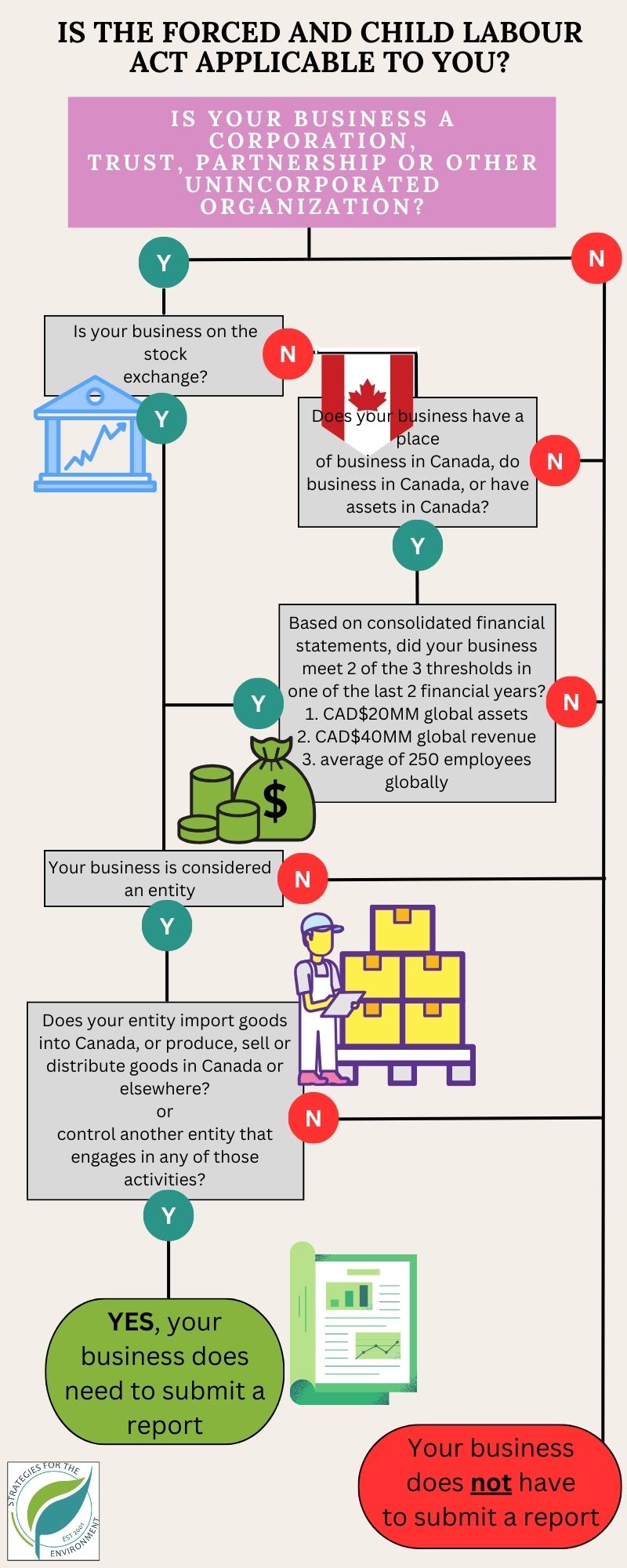
The first thing that every organization should do is follow this flow chart to determine if the Act is applicable to your business.
Understanding the reporting requirements
If you are subject to the reporting requirements, you must submit your report to the Minister of Public Safety on or before May 31 of each year.
Reporting includes:
1. A written report with approval and a signed attestation from the business’ governing body. The report describes “the steps the entity has taken during its previous financial year to prevent and reduce the risk that forced labour or child labour is used at any step of the production of goods in Canada or elsewhere by the entity or of goods imported into Canada by the entity.” Click on this link to get the mandatory information required in the report.
2. Completing the online questionnaire. You can view the questions in advance by clicking on this link.
3. Publishing the report on your website.
It will also be made publicly available by Public Safety Canada in an online catalogue.
If the Act doesn’t apply to you
Your business is part of a supply chain. You may not be required to submit a report but perhaps one of the businesses your work with does. When they are completing their report, they may as you how your business mitigate the risks.
You may consider assessing the risks in your supply chain and developing a policy to demonstrate your commitment to preventing and reducing the risk of forced labour and child labour.
How does this impact my management system (such as ISO 9001)?
When we turn to the ISO management system and how its affected, we look to the very first requirements.
Understanding the organization and its context
Understanding the context of the organization includes identifying relevant external issues. In this case if you operate in an industry which has a risk of forced or child labour in the supply chain, it is essential to identify this as a risk to your business.
ISO 9001:2015 – 4.1 Understanding the organization and its context
The organization shall determine external and internal issues that are relevant to its purpose and its strategic direction and that affect its ability to achieve the intended result(s) of its quality management system.
Understanding the needs and expectations of interested parties
When reviewing your list of interested parties in light of this new legislation, you will review the needs and expectations of the Federal Government, Suppliers and Clients.
One thing to remember is the reports you submit will be part of a searchable catalogue on the Public Safety website. You may want to ensure that you are considering how this can affect the public’s perception of your business as well as your shareholders.
ISO 9001:2015 – 4.2 Understanding the needs and expectations of interested parties
Due to their effect or potential effect on the organization’s ability to consistently provide products and services that meet customer and applicable statutory and regulatory requirements, the organization shall determine:
a) the interested parties that are relevant to the quality management system
b) the requirements of these interested parties that are relevant to the quality management system.
The organization shall monitor and review information about these interested parties and their relevant requirements.
Evaluation of Suppliers
The most significant step you can take to prevent and reduce the risk of forced labour and child labour is to properly vet your suppliers. You can update your selection and evaluation criteria and if you are in an industry which is more at risk, you can ask them for their policy against forced and child labour.
ISO 9001:2015 – 8.4 Control of externally provided processes
The organization shall determine and apply criteria for the evaluation, selection, monitoring of performance, and re-evaluation of external providers, based on their ability to provide processes or products and services in accordance with requirements.
There are some additional requirements from ISO 45001:2018.
Procurement
Beyond vetting suppliers, the Occupational Health and Safety Management Standard requires that the selection and evaluation process for Contractors include health & safety criteria. You may want to review your contracting practices to ensure you are taking the necessary steps to prevent forced or child labour.
ISO 45001:2018 – 8.1.4.2 Contractors
The organization shall ensure that the requirements of its OH&S management system are met by contractors and their workers. The organization’s procurement process(es) shall define and apply occupational health and safety criteria for the selection of contractors.
Legal requirements
Finally, update your Legal Register to include the new legislation and make sure that you add the annual report to your compliance calendar.
ISO 45001:2018 – 6.1.3 Determination of legal requirements and other requirements
The organization shall establish, implement and maintain a process(es) to:
a. determine and have access to up-to-date legal requirements and other requirements that are applicable to its hazards, OH&S risks and OH&S management system;
b. determine how these legal requirements and other requirements apply to the organization and what needs to be communicated;
c. take these legal requirements and other requirements into account when establishing, implementing, maintaining and continually improving its OH&S management system,